Medicaid-approved NEMT provider.
NPI # 1407551989
NPI # 1407551989
Transporting patients in wheelchairs may look simple from the outside. Open the ramp, roll the wheelchair in, lock the brakes, and drive, right?
Not quite.
A wheelchair is not just another seat on wheels. In a moving vehicle, it needs the right securement, the patient needs the right restraint, and the caregiver or driver needs to understand what can go wrong during sudden stops, turns, or crashes.
Think of it like carrying a cup of hot coffee in a car. If the cup is not steady and the lid is loose, even a short drive can turn messy fast. Wheelchair transportation works the same way, except the stakes are much higher.
This guide is intended for family caregivers, healthcare workers, and anyone responsible for transporting patients in wheelchairs and explains how to transport a patient in a wheelchair, when a patient should transfer to a vehicle seat, how to secure the wheelchair, and when professional wheelchair transportation is the safer choice.
Transporting wheelchair patients is common for doctor visits, dialysis, rehab, hospital discharge, family events, and daily errands. But even a short ride can become risky if the wheelchair or patient is not secured correctly.
The National Highway Traffic Safety Administration says seat belts saved an estimated 14,955 lives in 2017, and front-seat passenger car occupants can reduce fatal injury risk by 45% when they buckle up properly. NHTSA also notes that many fatal crashes happen within 25 miles of home and at speeds below 40 mph, which is a good reminder that “we’re only going a few blocks” is not a safety plan. [1]
For wheelchair transportation, the safety picture has another layer. The University of Michigan Transportation Research Institute explains that riding in a wheelchair as a vehicle seat is not fully covered by U.S. Federal Motor Vehicle Safety Standards. Because of that gap, industry groups created voluntary wheelchair transportation safety standards to improve protection for wheelchair-seated riders. The Wheelchair Transportation Standards for North America (WTS) are voluntary standards that encourage mobility device manufacturers to include crash protection in their chairs and devices. [2]
In plain English: you need the right setup, not just good intentions.
Before loading the vehicle, ask one important question:
Can the patient safely transfer into the vehicle seat?
This decision matters because the vehicle’s original seat and seat belt are designed for crash protection. When a patient can safely move from the wheelchair to the vehicle seat, that is often the better option. In general, an ambulance is reserved for emergencies, while scheduled medical trips are usually handled through wheelchair transportation or nemt providers.
But not every patient can do that safely. Some patients need to stay in their wheelchair because of weakness, poor balance, pain, surgery recovery, medical equipment, limited trunk control, or because the destination also needs to be prepared to support the patient safely on arrival.
When transferring to the vehicle seat may be better
A transfer may be appropriate when the patient:
After the transfer, the wheelchair should be folded, stowed, or secured so it does not move during the ride.
When the patient may need to stay in the wheelchair
A patient may need to remain in the wheelchair when they:
If the patient stays in the wheelchair, the wheelchair becomes the seat for that ride. That means the chair and the patient both need proper securement.
Safe transportation starts before the wheelchair moves toward the ramp or door. A rushed setup is one of the easiest ways to create risk, so follow applicable regulations and U.S. Department of Transportation guidance as part of the vehicle setup.
Park on a flat, stable surface
Choose a loading area that is as flat and clear as possible. Avoid gravel, steep driveways, wet pavement, curbs, potholes, and tight spaces near traffic.
Before loading:
Check the ramp or lift
If you are transporting a wheelchair in a vehicle with a ramp or lift, inspect it before use.
Check that:
Under DOT ADA standards, vehicles 22 feet or shorter must provide at least one wheelchair space with a clear 30-by-48-inch floor area.
This is especially important with power wheelchairs because they can be much heavier than manual chairs.
Clear the inside of the vehicle
Loose items can become hazards during a sudden stop. Before loading the patient, secure:
Also check that the floor anchors are visible and that the tie-down straps are not twisted, frayed, dirty, or tangled. Roomy wheelchair accessible vehicles, often converted minivans, are usually easier to load and secure because of their ramps and interior layout.
The wheelchair should be checked before loading, just like a driver checks mirrors before pulling onto the road.
Wheelchair preparation checklist
Before transporting wheelchair patients, check the following:
Wheelchair brakes help during loading and transfers, but they do not replace a tie-down system. Brakes are made to hold the chair still during normal use, not to manage crash forces.
Some wheelchairs are designed and tested for use as a seat in a motor vehicle. These are often called WC19 wheelchairs or wheelchairs with a transit option. WC19 compliant wheelchairs are specifically designed for safe transport in vehicles, having met crash test requirements and featuring designated tie-down points for securement.
UMTRI explains that WC19 sets minimum design and performance requirements to improve safety for wheelchair-seated riders during normal transport and crashes. [3] In practice, compliance means the chair is designed for safe transport and has been crash tested for use in vehicles.
A WC19 wheelchair usually has marked securement points where tie-down straps should attach, with designated tie-down points that should be verified rather than assumed. That makes securement easier and safer.
If the wheelchair is not WC19-compliant, use strong structural frame points only. Do not attach tie-down straps to weak or removable parts.
Do not attach tie-down straps to:
The goal is simple: attach the securement system to the strongest part of the chair, not the most convenient part.

A safe ride should also feel calm and respectful. Nobody wants to feel like cargo.
Before moving the patient, sanitize your hands before and after providing assistance. Explain what you are doing. Ask if they are ready. Let them tell you about pain, dizziness, shortness of breath, anxiety, or discomfort.
Patient preparation checklist
Before loading or transferring:
This small conversation can prevent big problems. It also helps the patient feel respected and involved, and having needed support readily available reduces stress at pickup and arrival.
If the patient can safely transfer to the vehicle seat, take your time. A transfer is not a strength contest. It is a coordinated move.
Basic assisted transfer steps
A safe transfer may include these steps:
Never pull the patient by the arms, shoulders, or clothing. That can hurt the patient and the caregiver.
When not to attempt a manual transfer
Do not try to manually lift or transfer the patient alone if they:
OSHA reports that patient handling tasks, including lifting, transferring, and repositioning, are a major source of musculoskeletal injuries for healthcare workers. In 2017, nursing assistants had 18,090 days-away-from-work musculoskeletal disorder cases, with a rate of 166.3 per 10,000 workers. [4]
NIOSH also states that safe lifting programs using mechanical lifting equipment can protect workers, reduce injury-related costs, and improve care quality. [5]
So, if a transfer feels unsafe, do not “muscle through it.” Use proper equipment or call professional transportation.
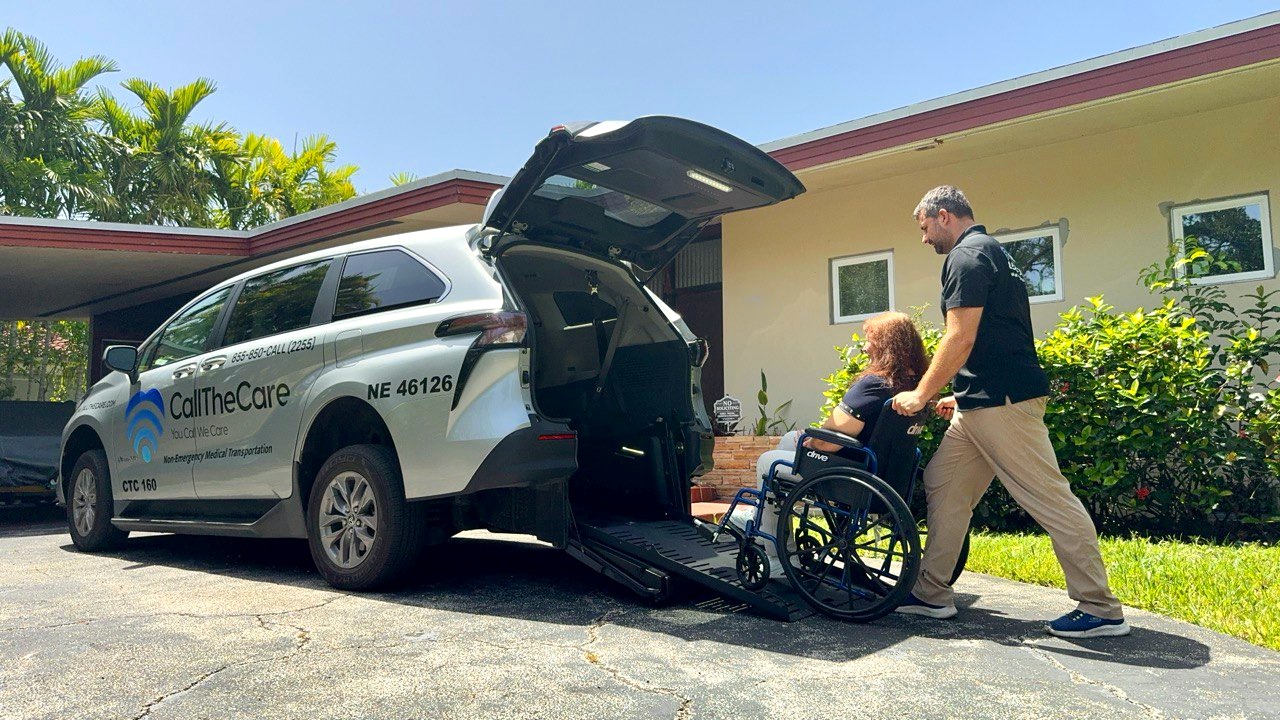
When transporting a wheelchair patient in a vehicle while they remain seated in the wheelchair, position matters.
The wheelchair should be:
Wheelchair transportation standards for tiedown and occupant restraint systems apply to forward-facing wheelchairs in vehicles. [6]
Avoid side-facing travel unless the vehicle has a specialized system made for that setup. For most personal and medical transportation vehicles, forward-facing is the safer and more practical standard.

A 4-point wheelchair tie-down system uses four straps to secure the wheelchair to the vehicle floor: two in the front and two in the rear.
UMTRI explains that the 4-point strap-type tiedown system is widely used because it can adapt to many wheelchair types and sizes. UMTRI also notes that this type of system has worked well in securing many wheelchair models in 30-mph frontal impact crash tests. [7]
How the 4-point tie-down system works
The system should:
Front tie-down straps
Attach the front straps to the front securement points or strong front frame areas. Keep the straps straight and untwisted. Tighten them until the chair is stable.
Rear tie-down straps
Attach the rear straps to the rear securement points or strong rear frame areas. Remove slack and make sure the straps pull the wheelchair securely into position.
Do not use the wrong equipment
Do not secure the wheelchair with:
Those items are not made to protect a wheelchair-seated patient during vehicle travel.

This is where many mistakes happen.
The tie-down system secures the wheelchair. It does not secure the patient’s body. The restraint protects the person while the tie-down protects the chair, and both are needed to reduce injury risk.
A patient riding in a wheelchair needs a proper lap-and-shoulder occupant restraint whenever available. UMTRI’s WC18 guidance says pelvic and shoulder restraints are used in testing and recommends using both belts during transport, especially in vehicles that normally have occupant restraint belts installed. [6]
Correct lap belt position
The lap belt should:
NHTSA gives the same basic belt-fit rule for vehicle passengers: the lap belt should rest across the hips, not the stomach. [1]
Correct shoulder belt position
The shoulder belt should:
NHTSA warns that improper seat belt use, including placing the strap under the arm, puts passengers at risk in a crash. [1] Improperly secured wheelchairs are linked to about 35% of reported injuries during vehicle travel for wheelchair users.
A wheelchair positioning belt is not enough
Many wheelchairs have belts that help with posture. These belts may help the patient sit upright, but they are not the same as vehicle crash restraints used with vehicle seats.
A simple rule helps here:
The wheelchair belt supports posture. The vehicle restraint protects the patient during travel.
For many patients, an upright seated position helps the restraint system work better.
UMTRI notes that WC19 wheelchair guidance includes warnings that the wheelchair backrest should generally not be reclined more than 30 degrees from vertical, because too much recline can reduce shoulder belt contact and increase crash forces on the body. [8]
That does not mean every patient can sit perfectly straight. Some medical conditions require tilt or recline. But if reclining is not medically needed, keep the patient as upright as possible and make sure the lap-and-shoulder belt stays close to the body.
Safe transportation does not end when the wheelchair is secured. The driver still needs to drive with care.
During the ride:
On longer rides, check in regularly. A simple “Are you still comfortable?” can catch a problem early.
Even caring families and new caregivers can make mistakes. Here are the big ones to avoid.
Mistake 1: Only locking the wheelchair brakes
Wheelchair brakes are not vehicle restraints. They may stop the wheels from rolling during loading, but they will not secure the chair during sudden braking or a crash.
Mistake 2: Securing the wheelchair but not the patient
A tied-down wheelchair does not automatically protect the person sitting in it. The patient still needs a proper occupant restraint.
Mistake 3: Using cargo straps or rope
Cargo straps may hold boxes in a truck, but wheelchair transportation is different. Use equipment made for wheelchair securement and occupant restraint.
Mistake 4: Attaching straps to weak parts
Wheels, armrests, footrests, and removable parts can break or detach. Use marked securement points or strong frame areas.
Mistake 5: Letting the wheelchair face sideways
For most wheelchair transportation, forward-facing placement is the safer standard.
Mistake 6: Routing the belt over the wheelchair
Seat belts need to fit the patient’s body, not the wheelchair. A belt routed over armrests or wheels may fail to protect the patient correctly.
The right equipment depends on the patient, wheelchair, vehicle, trip length, and whether the route and arrival plan must accommodate posture and support needs during transport.
Helpful equipment may include:
Ramps should meet safe capacity and slope expectations, supporting at least 600 pounds with a slope no steeper than a 1:8 ratio.
NHTSA recommends consulting qualified professionals when choosing adapted vehicles or equipment. Driver rehabilitation specialists can advise on seating, entering and exiting the vehicle, modified vehicle purchases, wheelchair lifts, and other transportation safety needs for passengers with disabilities. Paratransit services are specialized door-to-door options for people who cannot use regular public transportation. [9]
Family caregivers do a lot. But some trips require more than a regular car, good intentions, and trained drivers when the trip involves more than basic family assistance.
Professional wheelchair transportation may be the better choice when:
This is especially true for medical appointments, dialysis, rehab, hospital discharge, and long-distance non-emergency medical transportation.
For families in South Florida, CallTheCare offers private-pay wheelchair transportation across Miami-Dade, Broward, and Palm Beach. South Florida healthcare facilities and contracted transport companies must follow state-specific legal requirements to transfer wheelchair-reliant patients. Our wheelchair service helps riders with mobility challenges get to appointments, treatments, and everyday destinations safely and on time. CallTheCare also provides long-distance medical transportation, including long-distance wheelchair transport, and hospital discharge transportation for patients who need help getting home after care. Our fleet page is also useful for readers who want to see the types of vehicles used for non-emergency medical transportation.
Use this quick checklist before each trip:
Usually, yes, if the patient can transfer safely. The vehicle’s original seat and seat belt are designed for crash protection. If the patient cannot transfer safely, they may need to stay in the wheelchair with proper wheelchair tie-downs and occupant restraints.
Usually not safely. A patient who stays seated in a wheelchair during travel needs enough interior space, approved floor anchors, wheelchair tie-downs, and occupant restraints. A regular car may work only if the patient transfers into the vehicle seat and the wheelchair is safely stored.
A 4-point wheelchair tie-down uses four straps to secure the wheelchair to the vehicle: two in the front and two in the rear. The straps attach to approved vehicle anchors and strong wheelchair securement points.
No. Cargo straps, ropes, and bungee cords are not made for transporting wheelchair patients. Use a proper wheelchair tie-down and occupant restraint system.
The wheelchair should face forward in most transportation settings. Forward-facing placement helps the securement and restraint system work as intended.
Use marked securement points on a WC19 wheelchair when available. If the wheelchair does not have marked points, use strong structural frame points. Do not attach straps to wheels, armrests, footrests, or removable parts.
No. A wheelchair belt often supports posture, but it is not the same as a vehicle occupant restraint. The patient should use a proper lap-and-shoulder restraint whenever available.
Call a professional when the patient cannot transfer safely, the caregiver does not have proper equipment, the wheelchair is heavy or powered, medical equipment is involved, or the trip requires trained help.
[1] National Highway Traffic Safety Administration. Seat Belts.
https://www.nhtsa.gov/risky-driving/seat-belts
[2] University of Michigan Transportation Research Institute. Wheelchair Transportation Safety Standards.
https://wc-transportation-safety.umtri.umich.edu/wheelchair-transportation-safety-standards/
[3] University of Michigan Transportation Research Institute. FAQ: WC19 Wheelchairs.
https://wc-transportation-safety.umtri.umich.edu/faq-c1/
[4] Occupational Safety and Health Administration. Safe Patient Handling.
https://www.osha.gov/healthcare/safe-patient-handling
[5] National Institute for Occupational Safety and Health. Safe Lifting and Movement of Nursing Home Residents.
https://www.cdc.gov/niosh/docs/2006-117/default.html
[6] University of Michigan Transportation Research Institute. FAQ: WC18 Wheelchair Tiedown and Occupant Restraint Systems.
https://wc-transportation-safety.umtri.umich.edu/faq-b1/
[7] University of Michigan Transportation Research Institute. FAQ: 4-Point Strap-Type Tiedown Systems.
https://wc-transportation-safety.umtri.umich.edu/faq-c8/
[8] University of Michigan Transportation Research Institute. FAQ: Wheelchair Backrest Recline and WC19 Guidance.
https://wc-transportation-safety.umtri.umich.edu/faq-c13/
[9] National Highway Traffic Safety Administration. Adapted Vehicles.
https://www.nhtsa.gov/vehicle-safety/adapted-vehicles